Sinkholing JoyBot, a new Linux and Android IoT botnet
Reverse engineering of a new Mirai-like botnet strain in the wild, and an analysis of the flaws in its code that allow defenders to disrupt it.
JoyBot is a DDoS and proxy botnet for Linux servers, routers and Android devices, active since October 2026. The Houdin Research team reverse engineered some of its samples using Redacted. Internal tool, not public yet. and identified a flaw in its Command & Control code, which allowed us to sinkhole its latest builds.
Key findings
- JoyBot is written in C, built for about twenty CPU architectures, and distributed since at least 11 October 2026.
- It behaves like Mirai but leverages a custom command protocol, rootkit, privilege escalation and Android pivoting capabilities.
- The malware is under active development: we observed four generations in five weeks, each with a new command protocol.
- A flaw in the threat actor’s operations allowed us to sinkhole the latest builds of the botnet, effectively stopping their spread.
Campaign overview
Our first sighting was a Mirai-labeled aarch64 build uploaded to MalwareBazaar on 17 November. This sample stood out from the rest because it did not behave like Mirai in its TTPs: persistence, a kernel-module rootkit and spreading to Android devices over ADB.
The binary contained several indicators of deliberate branding: JOYBOT_* environment variables, key labels such as joybot-v9-session-v1, and a kernel module compiled from /root/JoyBot/kernel_hide_lkm.c. One antivirus engine has detected it as Trojan.Linux.Joybot since 11 November.
We found no public analysis or naming of JoyBot before this one which is the reason for this article.
Over five weeks the bots were delivered from three different IPs, and the code went through four generations (Figure 1).
The three IPs likely belong to the same operator. All three served JoyBot builds, two of them served the same installer script for the botnet, and honeypots logged the same mass scanning from these two.
Kill chain
Initial access
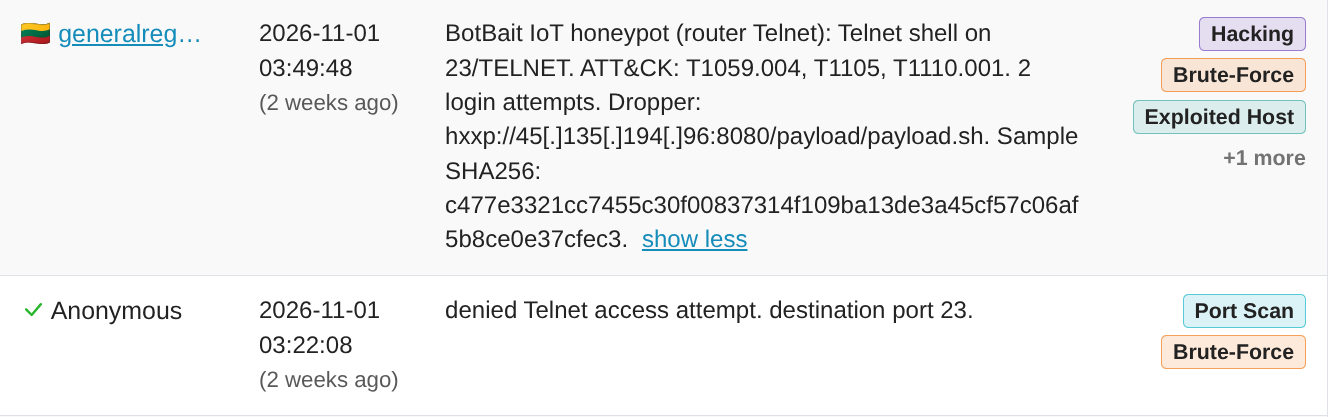
JoyBot gets in mainly by guessing Telnet passwords. A router honeypot caught 176.65.149[.]195 logging in after two attempts and downloading the bot (Figure 3).
The same IP also scanned for the web panel of Four-Faith industrial routers, and two of the infected devices we later observed are Four-Faith routers with this panel exposed. We did not recover an exploit, so the way in may be default credentials or a panel vulnerability.
Infected Linux hosts can also infect Android devices on their network (see Lateral movement).
Delivery
The device downloads a script that tries the bot build of every CPU architecture until one runs. A second installer, setup.sh, checks the bot’s signature before installing it. At most one antivirus engine in 60 flags these scripts on VirusTotal.
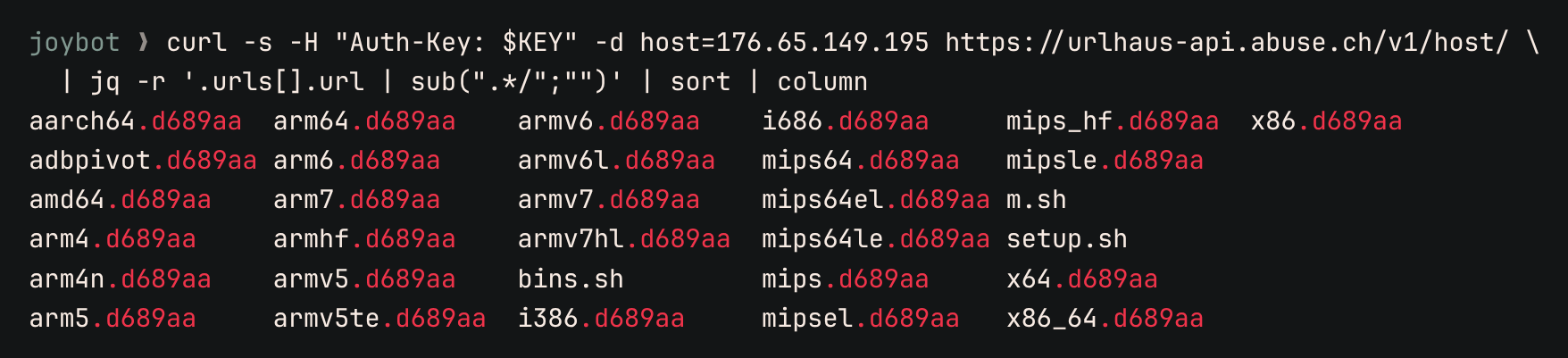
On 15 November, URLhaus listed 31 files on 176.65.149[.]195: 27 bot builds named after CPU architectures, the ADB pivot tool and three scripts (Figure 4). The .d689aa suffix is the first six hex digits of the update key fingerprint inside the build, so a new suffix marks a new key.
Privilege escalation
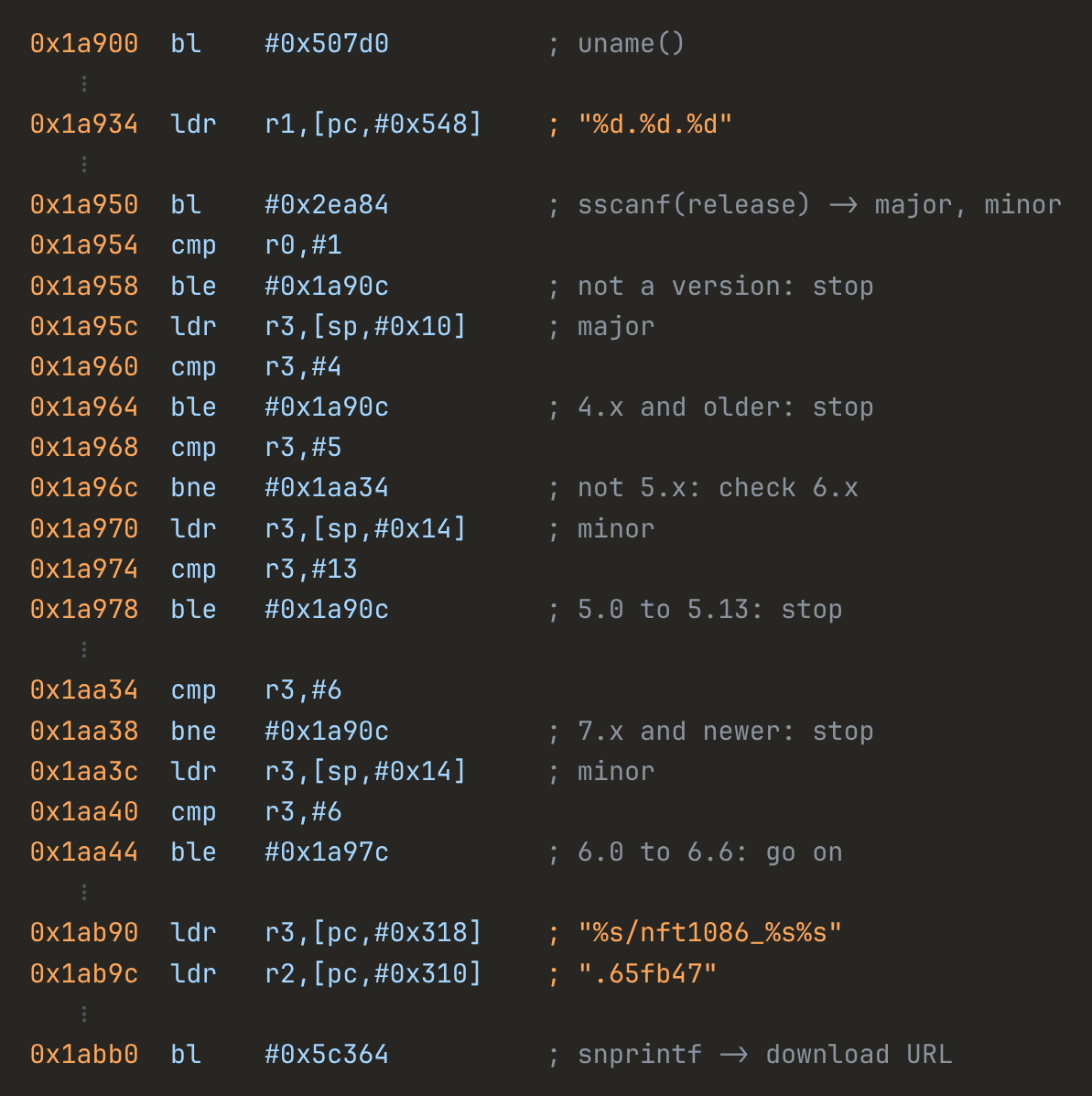
On kernels 5.14 to 6.6, the bot first downloads and runs a helper named nft1086 (Figure 5). This is the exact range of the public exploit for CVE-2024-1086, a flaw in the kernel’s nf_tables firewall, so the helper is very likely that exploit. We never obtained the file.
If that fails, it tries tools and interpreters with excessive permissions, then an escape from a privileged Docker or LXC container.
Persistence
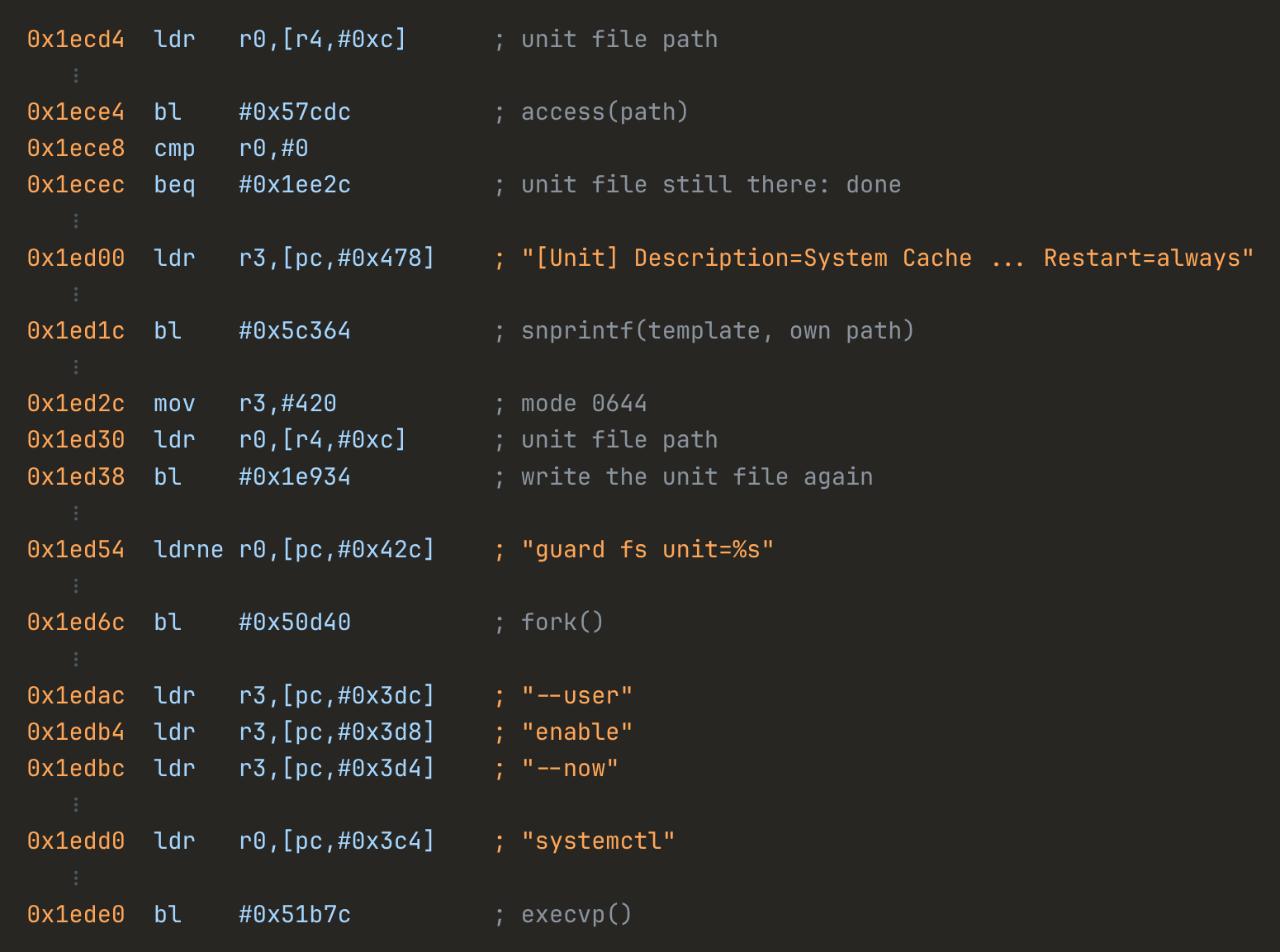
The bot installs itself under names that look like system services, mostly ntp-sync (systemd unit, cron job and init script). A watchdog process reinstalls the bot when it is killed, and writes the systemd unit again if someone deletes it (Figure 6). On Android it persists through a Magisk module.
Defense evasion
- A kernel rootkit,
khide.ko, hides the bot’s process, files and network connections. - The bot runs under fake process names such as
[kworker/u4:2]. - It detects analysis tools (debuggers, sniffers, security sensors, honeypots) and scales down its activity as it finds more of them, up to exiting.
- It kills competing botnets, and the Telnet and SSH services it came in through, to keep the device for itself.
Command and control
The command protocol changed with each generation: new ports, then authentication, then a new handshake. One thing stayed the same in every November build: a JSON status message sent to the C2 over UDP 9091. It is the most reliable network indicator for this family.
Lateral movement
On command, an infected Linux host scans its local network for Android devices with the debugging interface (ADB) exposed. The operator can then run commands and install apps on each device found, without root on the target.
Impact
The bots run DDoS attacks (eleven flood types), relay the operator’s traffic as proxies, and give the operator a remote shell on the device.
Fallback domain and sinkhole
Each bot has one hardcoded C2 address and a short list of ports. When none of them answers, the bot connects to the domain c2.update-server[.]net instead (Figure 7).
Three mistakes by the operator let us take over this fallback:
- The domain was never registered. It had expired in 2022 and was free to take.
- The bots cannot be moved. The command meant to give the bots a new C2 address writes it to a file the bot never reads. Once the hardcoded server is gone, the operator has no way to reach these bots.
- The command signing key is a placeholder. Every build uses
joybot-beacon-v1-change-me, so whoever answers at the C2 address can send valid commands.
On 17 November 176.65.149[.]195, the main C2 IP went offline. We registered the fallback domain and pointed it at a passive server that logs incoming connections. This allowed us to record the number of affected devices and cut the threat actor’s access.
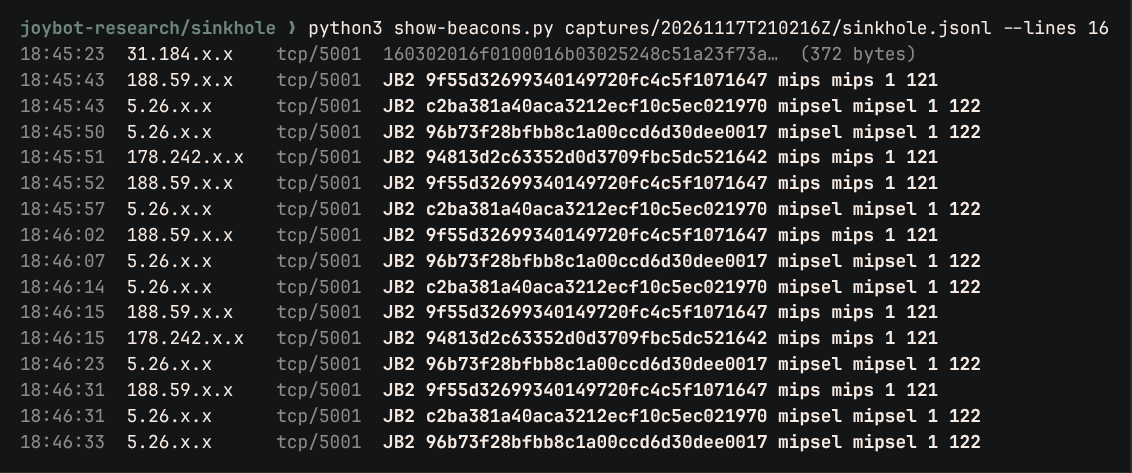
The first bots connected within minutes, each reporting an identifier, their CPU architecture and memory (Figures 8 and 9).
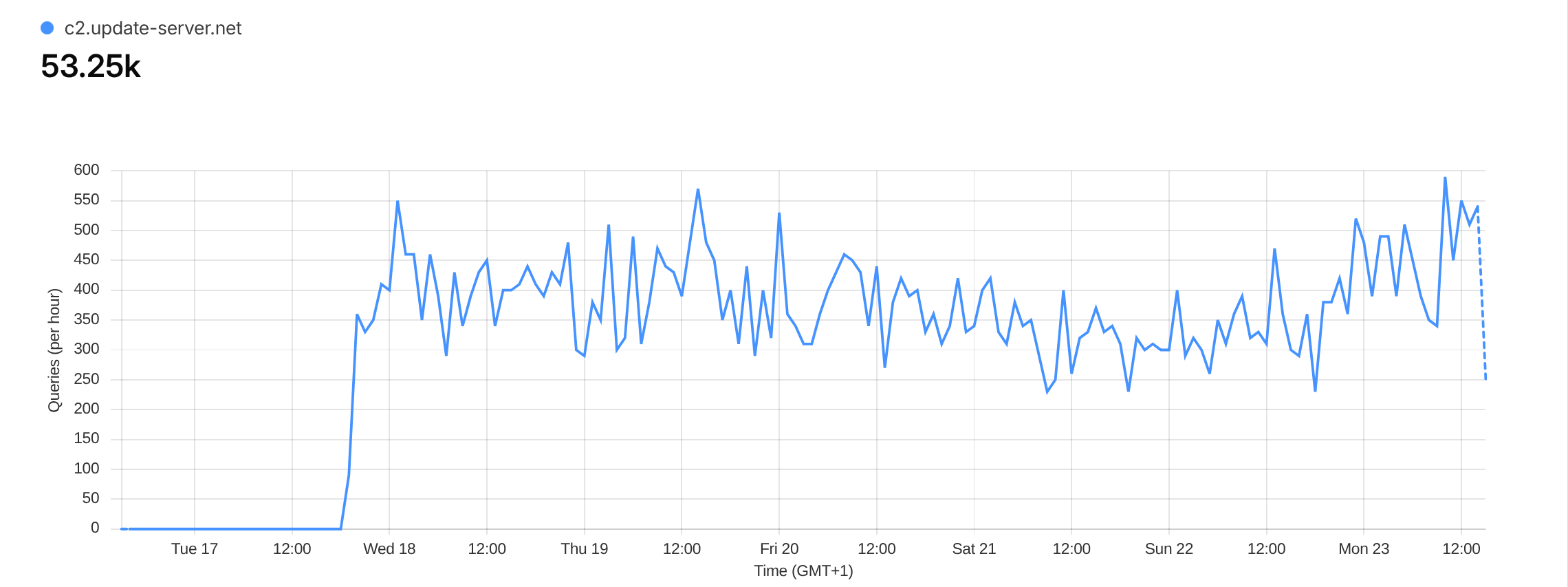
Since its registration, c2.update-server[.]net has received more than 53,000 DNS queries, between about 230 and 590 an hour around the clock (Figure 10).
Despite huge numbers in DNS telemetry we only identified less than 10 distinct infected devices: 5 from small MIPS devices from a Turkish ISP, 2 of them the Four-Faith routers mentioned above, and several hits from sandboxes probably launching the live samples for dynamic analysis.
The domain will be handed over to the Shadowserver Foundation for sinkholing and victim reporting.
Conclusions
- Classification. This new botnet strain is under active development, and later generations are likely to add capabilities. This article serves as a first naming of the JoyBot family and we will continue monitoring future activity.
- Operational errors. The operator invested in anti-analysis, but an unregistered domain, a broken migration command and a placeholder key left the whole fleet open to takeover.
- Fleet size. Fewer than ten devices reached the sinkhole. The next generation is unlikely to keep the same fallback.
- Stable indicators. The UDP 9091 telemetry, the
ntp-syncnames and the<arch>.<6 hex>download paths appear in every November build.
Detection
The YARA rules below match the five builds we obtained and the kernel module carved from the first one.
Bot and ADB pivot builds joybot_linux_bot
rule joybot_linux_bot
{
    meta:
        description = "JoyBot bot and ADB pivot builds, static C ELF for Linux and Android"
        reference   = "houdin.io/blog/joybot-linux-android-iot-botnet"
        date        = "2026-11-23"

    strings:
        // Migration command and install lock, present in every build
        $move  = "move cmd new_c2=%s:%d" ascii
        $lock  = ".gn_lock" ascii
        // Hidden install directories on Linux and Android
        $dir1  = "/root/.cache/.syscache" ascii
        $dir2  = "/data/adb/.syscache" ascii
        // Name of the ADB spreading module
        $pivot = "adbpivot" ascii
        // Default HMAC key and the two update pins seen so far
        $key   = "joybot-beacon-v1-change-me" ascii
        $pin1  = "65fb4710f17b8b57666414b8d4b681ce53de848e5fd2009cbe572725bdb20807" ascii
        $pin2  = "d689aab694130dd1baf99f7b25eb72311c0915a486773f436822124fa7914811" ascii

    condition:
        uint32(0) == 0x464c457f and filesize < 3MB and
        (3 of ($move, $lock, $dir1, $dir2, $pivot) or any of ($key, $pin1, $pin2))
}Kernel module joybot_khide_module
rule joybot_khide_module
{
    meta:
        description = "khide, the JoyBot kernel module hiding processes, paths, connections and itself through ftrace"
        reference   = "houdin.io/blog/joybot-linux-android-iot-botnet"
        date        = "2026-11-23"

    strings:
        // Source path left in the module by the operator
        $src    = "/JoyBot/kernel_hide_lkm.c" ascii
        // Kernel log lines
        $log1   = "khide: loaded hide_pid=" ascii
        $log2   = "khide: kprobe kallsyms_lookup_name failed" ascii
        // Module parameters
        $parm1  = "parm=hide_module:" ascii
        $parm2  = "hide_path" ascii
        $parm3  = "hide_port" ascii

    condition:
        uint32(0) == 0x464c457f and uint16(16) == 1 and
        ($src or any of ($log*) or all of ($parm*))
}
Indicators
| Hosts 3 | |
|---|---|
217.60.242[.]38 | |
45.135.194[.]96 | |
176.65.149[.]195 | |
| Fallback C2 1 | |
c2.update-server[.]net | |
| Stagers 4 | |
hxxp://45.135.194[.]96:8080/payload/payload.sh | |
hxxp://176.65.149[.]195/bins.sh | |
hxxp://176.65.149[.]195/setup.sh | |
hxxp://217.60.242[.]38/setup.local.sh | |
| Bots 4 | |
69cc6d2265d47a4e6b5bba24e54e875a906f0f7d312aaa69592f4df890b147a1 | |
15b5d09303c61d4fbb797b27205503c04f9c53f26422818194e1b07c4671ed4d | |
3c1b7ab149277e5e03e28c5c7f893406f57021b932fbc8194eea7a1b8020aa2e | |
1abc838a6d94994887bd9a8653198bf70f593365067647b046f8d5babf3e94d5 | |
| ADB pivot 2 | |
7f7444f52c9fa16a521756f295222587135f0ee73a5c07879c5905333356204f | |
6964aa6f0044501d05590b0445e2f7d89129130c8793c30070951dd23cd2e795 | |
| Kernel module 1 | |
d040f2548d8d618d5ccd5de7ed1c12afcc2bf47e5ca5d55c2a92cc88714351ed | |
| Scripts 6 | |
f18e20f45648f6c70c2237dc5ffeb2d58a257ebcce1a911d309bbf7a77ec1406 | |
31e6279e708058ac3549de2c7b38aaf194c90a9b5deaf4d6e776e6a031816688 | |
1d558c2eeadc1d2af4b56c8aeed88d99a39099125ff193498567da8a51e19678 | |
57d6869be28782450ca64b06857e5cf880d1bdf31f1c24f0a8d65e29c1fcc89a | |
c477e3321cc7455c30f00837314f109ba13de3a45cf57c06af5b8ce0e37cfec3 | |
198c6ac48bf9a38fe6e53e923624f73425125ffa51bf28173d19ff095a51bcc8 | |
MITRE ATT&CK
| Tactic | Techniques |
|---|---|
| Reconnaissance | T1595.001 |
| Initial access | T1110.001, T1078.001 |
| Execution | T1059.004 |
| Persistence | T1543.002, T1053.003, T1037.004, T1546.004 |
| Privilege escalation | T1068, T1548.001, T1611 |
| Defense evasion | T1014, T1036.004, T1036.005, T1620, T1562.001, T1497.001, T1622, T1027.013 |
| Discovery | T1046 |
| Command and control | T1105, T1071, T1008, T1090 |
| Lateral movement | T1021, T1570 |
| Impact | T1498.001, T1498.002, T1489 |
Method and scope
This investigation was run entirely on the Houdin platform, using passive intelligence only. Samples came from public malware repositories, nothing was fetched from the operator’s servers, and we never interacted with infected devices. The sinkhole only logs the connections it receives and never sends commands to the bots. Reverse engineering of the samples was entirely done with Redacted. Internal tool, not public yet.